

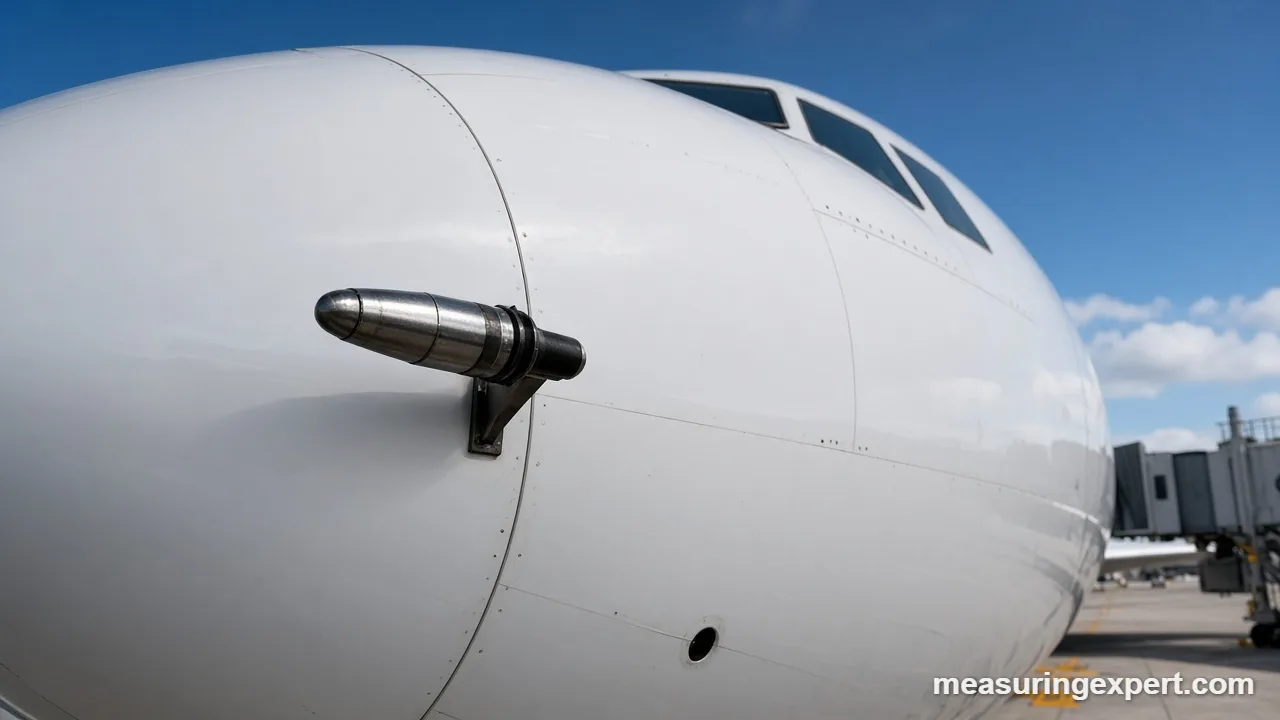
Airplanes measure speed through the air with a pitot-static system: a forward-facing pitot tube senses ram air pressure, static ports sense still-air pressure, and the airspeed indicator turns the difference into indicated airspeed in knots. Computers then correct it to calibrated and true airspeed, while GPS and inertial systems measure ground speed.
A car can count wheel turns to find its speed. However, an airplane has no wheels on the ground in flight, and the air around it moves with the wind, so it needs a different approach. In fact, a pilot cares about two separate speeds: how fast the wings move through the air, which decides whether the airplane keeps flying, and how fast the airplane moves over the ground, which decides when it arrives.
So every airplane carries at least one instrument for each job. First, a pressure-based airspeed indicator tells the pilot how much air flows over the wings. Next, a navigation source such as GPS reports ground speed. On top of that, faster jets add a Mach meter, because near the speed of sound the ratio to that speed matters more than knots.
In short: airspeed comes from air pressure, ground speed comes from navigation, and the two differ by the wind. Because of that, a jet can show 270 knots on its airspeed indicator, cruise at about 460 knots true airspeed, and cover the ground at 520 knots with a strong tailwind, all at the same moment.
The explanation below follows the Federal Aviation Administration’s Pilot’s Handbook of Aeronautical Knowledge, Chapter 8 (Flight Instruments), the same reference student pilots study for their written exam. In addition, the numbers for the speed of sound and true airspeed come from the International Standard Atmosphere, and we computed each one from its formula.
Convert Aircraft Speeds: Knots, mph and km/h
Pilots, controllers and flight trackers mostly quote speed in knots. Type any value below to see it in miles per hour, kilometers per hour, meters per second and feet per second. For example, 1 knot is exactly 1.852 km/h, or about 1.151 mph.
Recommended Tools for Measuring Airspeed and Wind
You do not need an airplane to work with these numbers. For example, student pilots use a flight computer to turn calibrated airspeed into true airspeed and to solve wind problems. In addition, a handheld anemometer shows the same idea on the ground: it measures how fast air moves past a sensor, which helps drone and model aircraft flyers check the wind before launch.



As an Amazon Associate, Measuring Expert earns from qualifying purchases.
- The pitot tube senses total (ram) pressure; the static ports sense ambient pressure.
- The airspeed indicator works as a differential pressure gauge between those two.
- Indicated airspeed (IAS) is the raw reading; calibrated airspeed (CAS) fixes instrument and installation error.
- True airspeed (TAS) corrects for thinner air: roughly 2 percent more than CAS per 1,000 feet.
- Ground speed equals TAS plus or minus the wind; GPS measures it directly.
- A Mach meter shows speed as a fraction of the local speed of sound.
- Knots match nautical miles, and 1 nautical mile is about 1 minute of latitude.
How Airplanes Measure Speed With the Pitot-Static System
The pitot tube is a small open tube that points straight into the airflow, usually under a wing or on the nose. As a result, when the airplane moves, air rams into its opening and stops. That stopped air pushes harder than the surrounding air, and the extra push is dynamic pressure. Together with the normal air pressure, it makes up the total pressure, also known as pitot pressure.
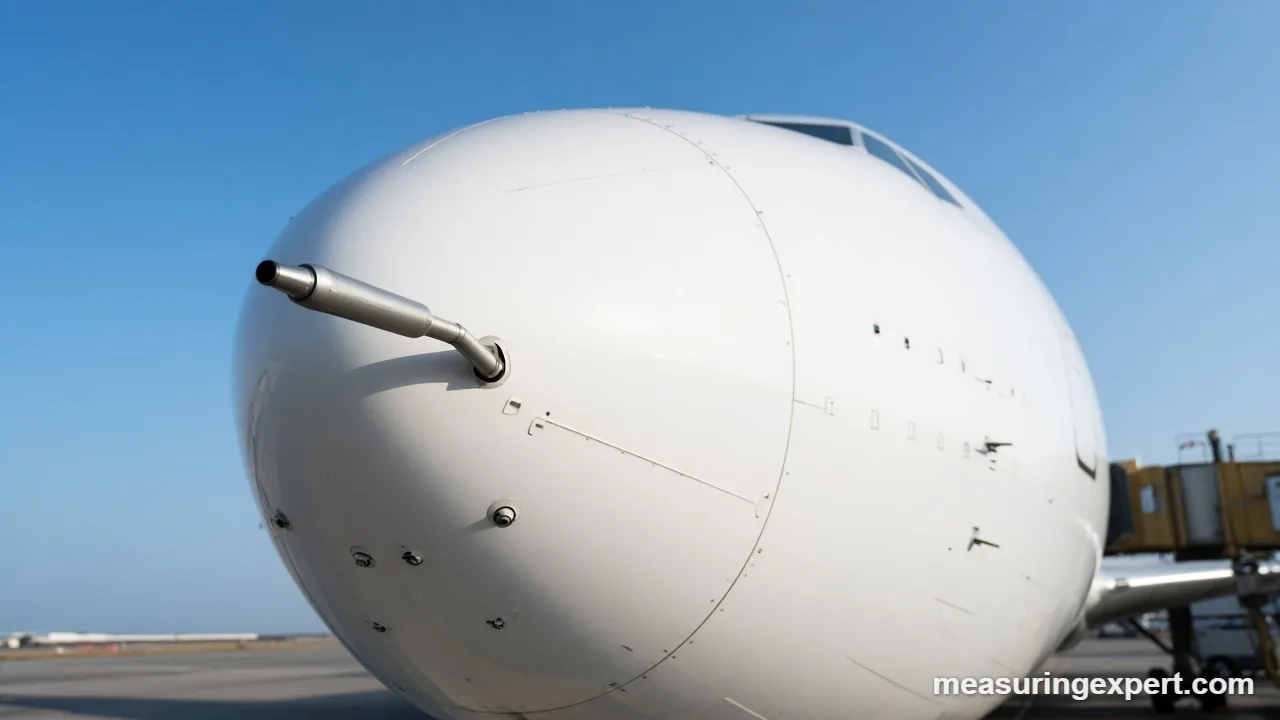
The static ports are flush holes on the side of the fuselage, placed where the airflow runs smoothly past them. Instead of facing the wind, they sense only the ambient (static) air pressure. According to the FAA handbook, these two pressures feed three instruments: the airspeed indicator, the altimeter and the vertical speed indicator. However, only the airspeed indicator uses both.
| Part | Where you find it | What it senses | Instruments it feeds |
|---|---|---|---|
| Pitot tube | Under a wing or on the nose, facing forward | Total pressure (static + dynamic) | Airspeed indicator |
| Static ports | Flush on the fuselage sides | Ambient static pressure | Airspeed indicator, altimeter, vertical speed indicator |
| Pitot heat | Built into the pitot tube | Nothing; it melts ice | Keeps the tube clear in cloud and rain |
| Air data computer | Avionics bay (jets and glass cockpits) | Pitot, static and air temperature | Digital IAS, TAS, Mach and altitude |
Because dynamic pressure grows with the square of speed, doubling the airspeed gives about four times the dynamic pressure. As a result, the instrument scale can read small speeds precisely and still cover fast cruise speeds.
Inside the Airspeed Indicator
The FAA describes the airspeed indicator as a sensitive differential pressure gauge. Pitot pressure flows into a thin metal diaphragm, while static pressure fills the sealed case around it. When the airplane speeds up, the diaphragm swells; similarly, when it slows, the diaphragm shrinks. Then gears and linkages turn that tiny movement into the motion of the needle. Similarly, in a glass cockpit, an air data computer does the same math electronically and draws a speed tape on the screen.
The dial also carries colored marks, so the pilot can read safe ranges at a glance:
| Marking | Range | Meaning |
|---|---|---|
| White arc | VS0 to VFE | Flap operating range; the bottom is the stall speed in landing configuration |
| Green arc | VS1 to VNO | Normal operating range; the bottom is the clean stall speed |
| Yellow arc | VNO to VNE | Caution range; fly here only in smooth air |
| Red line | VNE | Never-exceed speed; the airplane must never fly faster |
IAS vs CAS vs TAS vs Ground Speed
However, the single airspeed reading on the dial is only the start. Pilots correct it in steps, and each step answers a different question. Here is how the FAA handbook defines each one, with the question it answers:
| Speed | What it is | Who uses it |
|---|---|---|
| Indicated airspeed (IAS) | The uncorrected reading on the instrument | Pilots, for takeoff, landing and stall speeds |
| Calibrated airspeed (CAS) | IAS corrected for instrument and installation error | Manufacturers and flight test; differs most at low speeds |
| True airspeed (TAS) | CAS corrected for altitude and temperature (air density) | Flight planning and fuel math |
| Ground speed (GS) | TAS adjusted for wind | Arrival times; shown on GPS and flight trackers |
| Mach number | TAS divided by the local speed of sound | Jets at high altitude |
For example, at 8,000 feet a small airplane might show 120 knots CAS. Using the handbook’s rule of thumb of 2 percent per 1,000 feet, its true airspeed is about 139 knots. Then a 20-knot headwind cuts its ground speed to about 119 knots. Meanwhile, the airspeed indicator still reads 120, because the wing feels the same amount of air either way. To see typical numbers for real aircraft, read our guide on how fast planes fly at cruise.
How to Work Out True Airspeed and Ground Speed
Pilots once did this on a circular slide rule called an E6B. Today, an app or panel display does it for you; still, the steps show how airplanes measure speed in practice:
- Read indicated airspeed. Take the number from the airspeed indicator, for example 120 knots.
- Correct to calibrated airspeed. Look up the airspeed calibration table in the pilot’s operating handbook; at cruise the change is often a knot or two.
- Find pressure altitude and outside air temperature. Set the altimeter to 29.92 inHg to read pressure altitude, then check the outside air temperature gauge.
- Convert CAS to true airspeed. Use the E6B or a flight computer; as a quick check, add 2 percent of CAS for each 1,000 feet.
- Apply the wind. Subtract a headwind component or add a tailwind component to get ground speed.
- Compare with GPS. Check your result against the GPS ground speed, then use the converter above if you need mph or km/h.
The Mach Meter: How Jets Measure Speed Near the Sound Barrier
Mach number equals the airplane’s true airspeed divided by the local speed of sound, as NASA’s Glenn Research Center explains. The speed of sound depends on air temperature, not on pressure. At sea level on a standard 15 C (59 F) day, it is about 661 knots (761 mph, 1,225 km/h). At 35,000 feet, where the standard temperature drops to about -54 C (-66 F), it falls to roughly 576 knots.
A Mach meter takes the same pitot and static pressures as the airspeed indicator but adds an altitude capsule, so it reads the ratio directly. Consequently, airliners climb at a set indicated airspeed and then switch to a set Mach number once they get high. At 35,000 feet, Mach 0.80 works out to about 461 knots true airspeed (531 mph, 854 km/h), yet the airspeed indicator shows only about 272 knots. In other words, that gap is thin air at work. For the physics behind it, see our explainer on the speed of sound.
How Airplanes Measure Speed Over the Ground
Ground speed does not involve the air at all. Instead, a GPS receiver tracks satellite signals and works out its velocity from changes in position and from the Doppler shift of those signals. Also, it updates several times per second and shows ground speed and track on the navigation screen.
Airliners also carry inertial reference systems. For example, these use gyroscopes and accelerometers to sense every change in motion, then add up those changes to compute velocity and position without any outside signal. Because small errors build up over hours, modern systems blend inertial data with GPS. In addition, many aircraft broadcast their GPS ground speed through ADS-B, which is why flight tracking websites can show it.
Why Airplanes Measure Speed in Knots
A knot is one nautical mile per hour, and the nautical mile equals exactly 1,852 meters. In addition, that length sits very close to one minute of latitude, so 60 nautical miles cover about one degree of latitude. Since aviation charts use latitude and longitude, knots and nautical miles make distance and time math quick: a navigator can measure a leg against the latitude scale on the chart’s edge.
Aviation also inherited the unit from ships, and international rules for air traffic control allow knots and feet. Therefore, a US pilot, a German controller and a Japanese airline all talk in knots. Even so, some light aircraft built in the 1970s and earlier show mph on the dial, so pilots of those airplanes need to know which unit they have. For the full conversion breakdown, read how fast a knot is in mph and km/h.
| Knots | mph | km/h | Typical example |
|---|---|---|---|
| 1 kt | 1.151 mph | 1.852 km/h | Definition |
| 60 kt | 69 mph | 111 km/h | Approach speed of a small trainer |
| 250 kt | 288 mph | 463 km/h | US limit below 10,000 feet (indicated) |
| 461 kt | 531 mph | 854 km/h | Mach 0.80 true airspeed at 35,000 feet |
| 661 kt | 761 mph | 1,225 km/h | Speed of sound at sea level, 15 C |
What Happens When Airplanes Measure Speed Incorrectly
Because the pitot-static system depends on open holes, ice, insects, tape or water can block them. The FAA handbook lists the main failure patterns:
- Pitot tube blocked, drain hole open: the airspeed reading drops to zero.
- Pitot tube and drain hole both blocked: the trapped pressure turns the airspeed indicator into an altimeter; it reads higher in a climb and lower in a descent.
- Static ports blocked: the altimeter freezes, the vertical speed indicator shows zero, and airspeed reads too fast below the altitude where the blockage happened.
- Alternate static source in use: airspeed and altitude both read slightly high, because cabin pressure runs a little lower than outside.
Do and Don’t for Reading Aircraft Speed
Do
- Fly stall and approach speeds by indicated airspeed.
- Plan fuel and timing with true airspeed and wind.
- Check which unit the dial uses: knots or mph.
- Use pitot heat in visible moisture when cold.
- Cross-check airspeed against GPS ground speed.
Don’t
- Treat flight-tracker ground speed as airspeed.
- Forget the pitot cover on preflight.
- Expect TAS to match IAS at altitude.
- Ignore a sudden airspeed change with no power change.
- Mix nautical miles and statute miles in one calculation.
Honest Limits of Airspeed Numbers
Every speed on this page carries some error. First, the 2 percent per 1,000 feet rule assumes standard temperatures; for instance, our standard-atmosphere calculation for 120 knots CAS at 8,000 feet gives about 135 knots TAS, not 139. Second, calibration errors vary by airplane and flap setting, and they grow at low speeds and high angles of attack. Third, the Mach and speed-of-sound figures assume the International Standard Atmosphere; on a hot day the speed of sound rises, and on a cold day it falls. Finally, GPS ground speed is very accurate in steady flight, but it says nothing about how close the wing is to a stall. In short, use each speed for its own job.
When to Call a Professional
If an airspeed indicator sticks, jumps or disagrees with a second source, do not try to fix it yourself. Instead, an FAA-certificated mechanic or avionics repair station should inspect the pitot-static lines, drains and instruments. In the US, 14 CFR 91.411 requires the static system and altimeter to pass a test every 24 calendar months before flying under instrument flight rules in controlled airspace. Likewise, ask a flight instructor to explain your airplane’s calibration table and speed limits before you rely on them.
Frequently Asked Questions
How do airplanes measure speed in the air?
They compare the ram air pressure in a forward-facing pitot tube with the still-air pressure at the static ports. The airspeed indicator turns that pressure difference into indicated airspeed, usually in knots.
Do airplanes measure speed with GPS?
GPS measures ground speed, not airspeed. Pilots use it for navigation and arrival times, but they fly the airplane by airspeed from the pitot-static system, because the wing only feels the air.
What is the difference between airspeed and ground speed?
Airspeed is how fast the airplane moves through the air. Ground speed is how fast it moves over the ground. A headwind lowers ground speed and a tailwind raises it, while airspeed stays the same.
Why is true airspeed higher than indicated airspeed at altitude?
The air gets thinner as you climb, so the pitot tube feels less pressure at the same speed. As a rule of thumb, true airspeed is about 2 percent higher than calibrated airspeed for every 1,000 feet of altitude.
How do airplanes measure speed close to the speed of sound?
Jets use a Mach meter, which shows true airspeed as a fraction of the local speed of sound. At 35,000 feet, Mach 0.80 is about 461 knots true airspeed, or about 531 mph.
Why do pilots use knots instead of mph?
A knot is one nautical mile per hour, and a nautical mile is about one minute of latitude. That makes distance and time math on aviation charts simple, and international air traffic rules use knots.
How many mph is 1 knot?
One knot equals about 1.151 mph, or exactly 1.852 km/h. So 250 knots is about 288 mph or 463 km/h.
What happens if ice or bugs block the pitot tube?
If only the front opening blocks and the drain hole stays open, the airspeed drops to zero. If both block, the airspeed indicator acts like an altimeter and shows false increases in a climb.
How fast does a commercial jet fly?
Most airliners cruise around Mach 0.78 to 0.85, which is roughly 450 to 490 knots true airspeed at typical cruise altitudes. Ground speed can be much higher or lower depending on the jet stream.
How do airplanes measure speed without any outside signal?
Inertial reference systems use gyroscopes and accelerometers to sense every change in motion and compute velocity on board. Modern airliners blend that data with GPS to correct slow drift.
Bottom Line: How Airplanes Measure Speed
To sum up, airplanes measure speed in two worlds at once. Through the air, the pitot tube and static ports feed a pressure difference to the airspeed indicator, and pilots correct that reading to calibrated airspeed, true airspeed and, in jets, Mach number. Meanwhile, over the ground, GPS and inertial systems report ground speed, which differs from true airspeed by the wind.
Most of these numbers come in knots because nautical miles fit the latitude and longitude grid on every chart. So if you want to turn a cockpit number into mph or km/h, use the converter near the top of this page.