

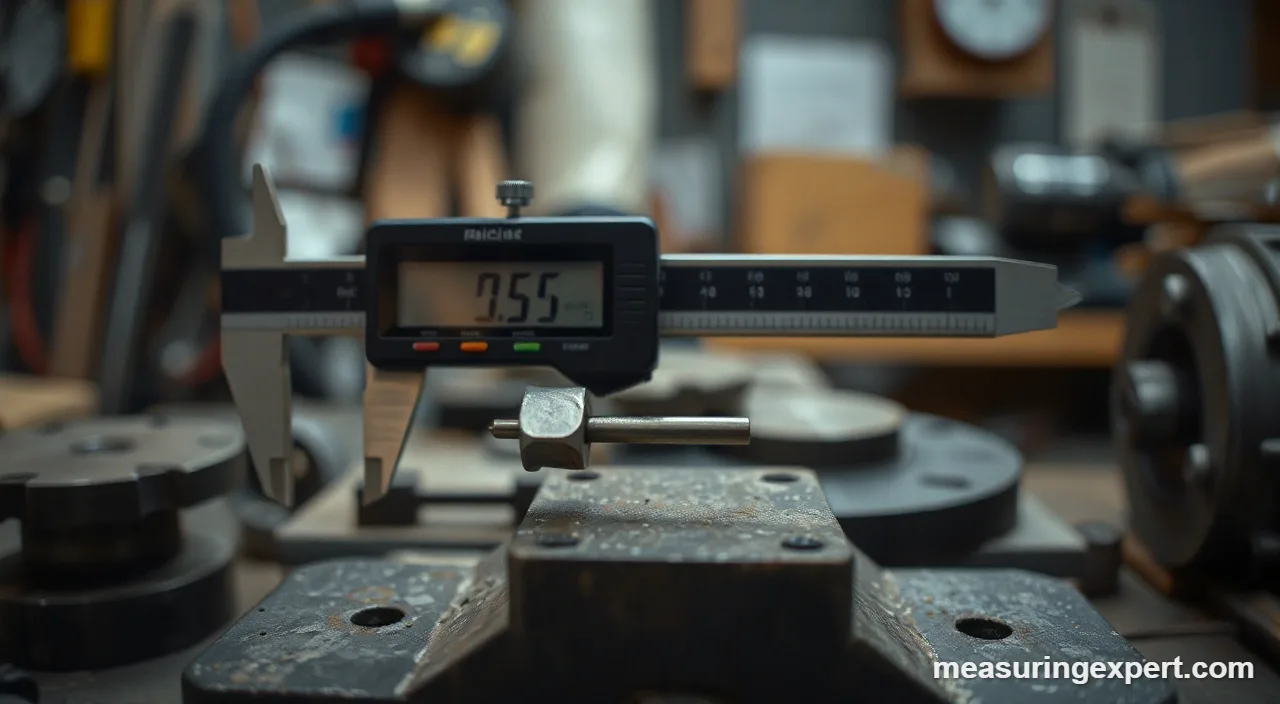
0.67 inch equals 17.02 mm, or 1.702 cm. As a fraction it is closest to 43/64 inch, and 11/16 inch (0.6875) is the nearest sixteenth. The conversion is exact because 1 inch is defined as 25.4 mm, a value NIST publishes, so you just multiply inches by 25.4.



Black Friday week: get the picks above delivered fast with Prime
A drawing comes back with “.67” in the corner of a part, and your tape measure has no decimal marks at all. Somebody says it is about five eighths; somebody else says two thirds; the machinist next door says eleven sixteenths. They cannot all be right, and the gap between them is bigger than it sounds.
Here is how it sorts out. In decimal form, .67 inch is 17.018 mm. The closest fraction with a power-of-two denominator is 43/64 inch (0.6719 in, 17.07 mm), while the common 1/16 inch reading is 11/16 inch (0.6875 in, 17.46 mm). Five eighths is clearly too small at 15.88 mm, and “two thirds” is a fraction with a different kind of denominator that happens to land at 16.93 mm, within 0.09 mm of .67 inch.
Below you will find those candidates side by side, a chart of decimal inches near .67, the steps to turn any decimal into a fraction, and notes on the metric look-alike that gets swapped with it most often, the 17 mm size. A short list of calipers and rules is included for readers who need to check a part with their own tool.
Key Takeaways
- .67 in = 17.02 mm = 1.702 cm.
- The nearest 1/16 inch reading is 11/16 inch; the nearest 1/64 is 43/64.
- 2/3 inch is within 0.09 mm of .67 inch.
- A 17 mm tool is close to .67 in but is not an 11/16 inch tool.
- Keep the decimal when tolerance matters.
Which fraction is .67 inch?
No single fraction equals .67 exactly, because 0.67 is 67/100 and rulers use denominators that are powers of two (2, 4, 8, 16, 32, 64). So you choose the finest mark your tool shows and accept a small gap. This table lists the candidates and shows how far each one is from .67 inch.
| Value | Decimal inches | Millimeters | Gap from .67 in | Where it comes from |
|---|---|---|---|---|
| 5/8 in | 0.6250 in | 15.88 mm | -1.14 mm | nearest 1/8 in |
| 11/16 in | 0.6875 in | 17.46 mm | +0.44 mm | nearest 1/16 in |
| 21/32 in | 0.6563 in | 16.67 mm | -0.35 mm | nearest 1/32 in |
| 43/64 in | 0.6719 in | 17.07 mm | +0.05 mm | nearest 1/64 in |
| 2/3 in | 0.6667 in | 16.93 mm | -0.08 mm | the “two thirds” reading |
| 17 mm | 0.6693 in | 17.00 mm | -0.02 mm | metric neighbor |
For woodworking and general building, 11/16 inch is the normal reading, though it is 0.44 mm long. For a shop drawing with a tolerance, use 43/64 inch or just keep the decimal.
Decimal inches near .67 in millimeters
Use this chart for neighbors of .67 inch. Millimeters are exact to two decimals, and the fraction column is the nearest 1/64 inch.
| Decimal inches | Millimeters | Centimeters | Nearest 1/64 in |
|---|---|---|---|
| .5 in | 12.70 mm | 1.270 cm | 1/2 in |
| .6 in | 15.24 mm | 1.524 cm | 19/32 in |
| .62 in | 15.75 mm | 1.575 cm | 5/8 in |
| .65 in | 16.51 mm | 1.651 cm | 21/32 in |
| .66 in | 16.76 mm | 1.676 cm | 21/32 in |
| .67 in | 17.02 mm | 1.702 cm | 43/64 in |
| .68 in | 17.27 mm | 1.727 cm | 11/16 in |
| .7 in | 17.78 mm | 1.778 cm | 45/64 in |
| .75 in | 19.05 mm | 1.905 cm | 3/4 in |
| .8 in | 20.32 mm | 2.032 cm | 51/64 in |
Each hundredth of an inch is 0.254 mm. That is why .66 and .68 inch are 16.76 mm and 17.27 mm, on either side of .67 inch at 17.02 mm. If you often work between inch and metric lengths, the guide to measuring length with fractions and metric scales shows how to read both on one tool.
How to turn a decimal inch into a fraction
You can convert any decimal inch the same way. These steps use .67 as the example, and the same method works for .43, .81 or 1.67 inch.
- Pick the smallest fraction your tool can show. A basic ruler reads 1/16 inch, so the denominator is 16.
- Multiply the decimal part by that denominator: 0.67 x 16 = 10.72.
- Round to the nearest whole number: 10.72 becomes 11.
- Write it over the denominator: 11/16 inch.
- Reduce the fraction if both numbers divide evenly (11/16 is already as small as it gets).
- Check by dividing: 11 / 16 = 0.6875, which is 0.0175 inch above .67. If that gap is too big for the job, repeat with 32 or 64.
Keep a card with 1/64 steps on it. Sixty-fourths are easier to find than they look: .67 inch is 42.88/64, which rounds to 43/64.
.67 in, 0.67 mm, 67 cm and 17 mm are not interchangeable
Dropping the leading zero in “.67” is common on shop drawings, but it is also an easy way to lose the decimal point entirely. The table shows what happens when the units or the decimal drift.
| If you meant | Millimeters | Inches | Notes |
|---|---|---|---|
| .67 in (0.67 inch) | 17.02 mm | 0.67 in | The length this page covers |
| 67 in | 1701.8 mm | 67 in | Over 5 feet, about 5.58 ft |
| 0.67 mm | 0.67 mm | 0.0264 in | A bit under 1/32 in, about a sheet of thin card stock |
| 67 cm | 670 mm | 26.38 in | Roughly 2.2 feet |
| 17 mm | 17 mm | 0.6693 in | A common metric wrench and socket size, close to .67 in |
A 17 mm socket and an 11/16 inch socket are close, yet 11/16 in is 17.46 mm. On a worn or rounded fastener, the wrong one can slip and chew the corners. Match the size stamped on the fastener or the tool, and test the fit by hand before applying force.
Reading .67 inch on a caliper or micrometer
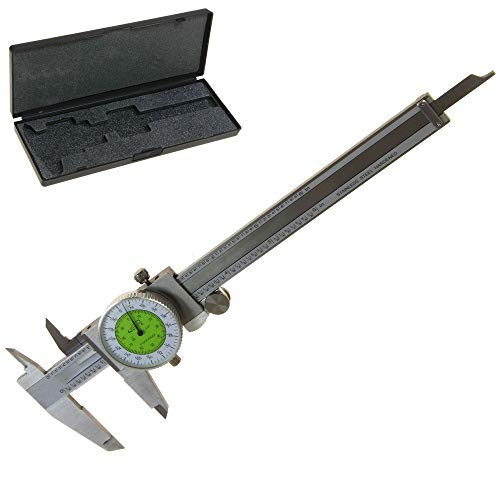
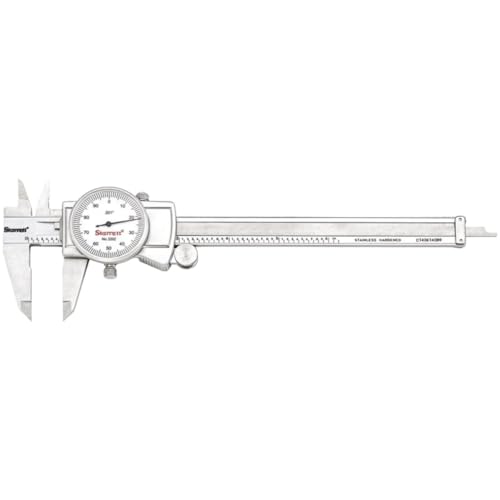
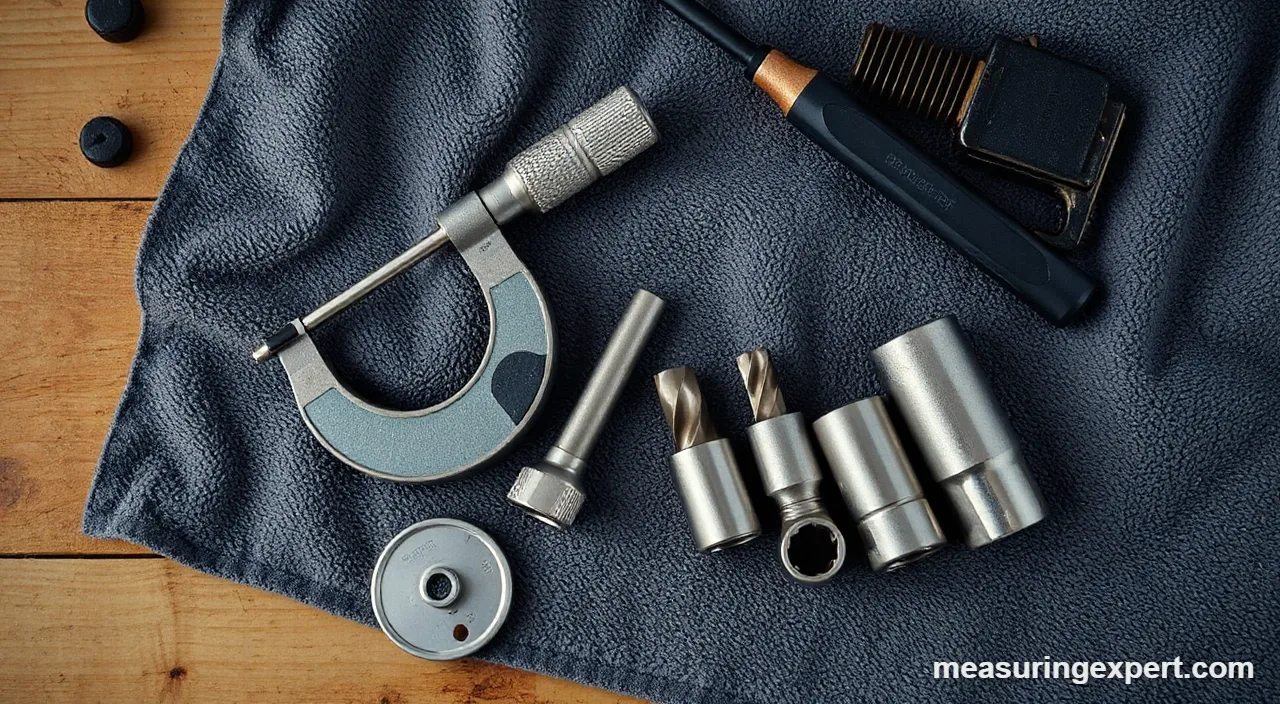
Digital and dial calipers show decimal inches, so .67 appears as 0.670 on the display. A caliper with 0.001 inch resolution lets you check a part to a few thousandths. Many dial calipers also have a fractional scale, which can help when the plan lists fractions but the stock is measured in decimals.
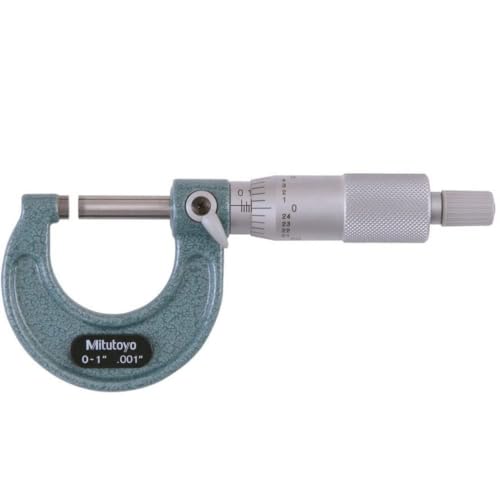
A micrometer is more precise than a caliper at this size: an outside micrometer reads to 0.001 inch and lets you feel the same clamping pressure each time. Zero the tool first, close it on the part gently, and read the number twice. For parts that must match a printed .670 inch, tolerances such as plus or minus .005 inch are common on general drawings, but always follow the number on your own drawing.
What is about .67 inch long in everyday life?
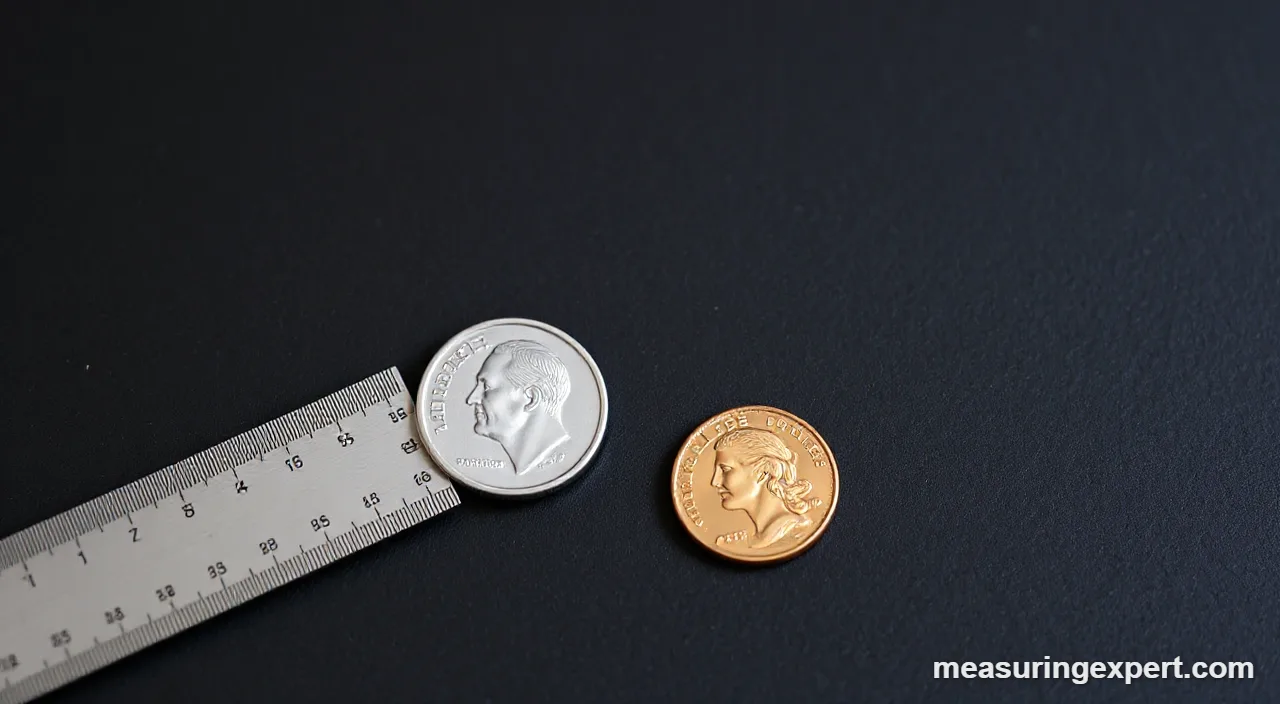
A US dime is 0.705 inch (17.91 mm) across, so .67 inch is a little smaller than a dime. A US penny is 0.75 inch (19.05 mm) wide, so .67 inch is about 89 percent of a penny. These coin sizes come from the US Mint specifications, and they make a handy pocket check when you do not have a ruler.
Similarly, a standard AA battery is about 14.5 mm in diameter, which is 0.57 inch, so .67 inch is a little wider than one. These comparisons are for rough picturing only.
Do and do not when you see .67 inch
Do
- Multiply inches by 25.4 to get millimeters, and keep two decimals.
- State the denominator you rounded to, such as “11/16 in, rounded to 1/16”.
- Use 43/64 inch or the decimal when tolerance matters.
- Zero your caliper before every measurement.
Do not
- Do not read .67 as 2/3 unless the plan says so; the difference is only 0.09 mm, but the intent matters.
- Do not read .67 as 5/8 inch. It is 1.14 mm too small.
- Do not swap a 17 mm tool for an 11/16 inch tool on a fastener.
- Do not drop the leading zero when you write your own notes.
Honest limits of any decimal-to-fraction answer
The conversion from inches to millimeters is exact, but turning a decimal into a fraction is always a rounding choice. Two people can both be correct when one says 11/16 inch and the other says 43/64 inch, because they used different tools. The “right” answer is the one that keeps the part within its allowed tolerance.
Measured parts add their own noise. A cheap caliper can be off by 0.001 to 0.002 inch, and a stretched or bent steel rule can mislead you more than that. Temperature, burrs and how hard you squeeze can change a reading by a thousandth of an inch or so. For that reason, take the measurement twice, and from two spots on the part.
The inch has been fixed at exactly 25.4 mm since the 1959 international agreement described on the NIST SI units of length page, so the arithmetic on this page never changes.
When accuracy really matters
For drilling, boring or machining, order drill bits, reamers and stock based on the decimal diameter, and check the fit with a gauge or the mating part. For plumbing, hardware and fasteners, choose by the size stamped on the product, because “close enough” can leak, wobble or strip. If an engineering drawing says .670 inch with a tolerance, ask the engineer or the machine shop before you substitute a fraction. When in doubt, a local calibration lab or machine shop can check a part against a certified gauge.
Calipers and rules for checking .67 inch
A caliper turns a decimal like .670 into a number you can read directly, and a steel rule with fine graduations helps you check a fraction. These picks are based on manufacturer specs and buyer reports, not on our own bench tests.
As an Amazon Associate, Measuring Expert earns from qualifying purchases.
Quick answers about .67 inch
How many mm is .67 inch?
.67 inch is 17.018 mm, usually written 17.02 mm. Multiply inches by 25.4 to get millimeters.
How many cm is .67 inch?
It is 1.7018 cm, or about 1.70 cm.
What fraction is .67 inch?
The nearest 1/64 inch is 43/64 (0.6719 in). To the nearest 1/16 inch it is 11/16 (0.6875 in), and to the nearest 1/8 inch it is 5/8 (0.625 in).
Is .67 inch the same as 2/3 inch?
Almost. 2/3 inch is 0.6667 inch or 16.93 mm, so it is 0.09 mm shorter than .67 inch. For most hobby and building work you can treat them as the same.
Is .67 inch bigger or smaller than 5/8 inch?
It is bigger. 5/8 inch is 0.625 inch (15.88 mm), so .67 inch is 1.14 mm longer.
Is .67 inch the same as 17 mm?
They are very close. 17 mm is 0.6693 inch, only 0.0007 inch (0.018 mm) under .67 inch.
How many feet is .67 inch?
.67 inch is 0.0558 feet, because you divide by 12.
How do I write .67 inch in thousandths?
It is 670 thousandths of an inch, written 0.670 in or 670 mil.
What is .67 inch in 1/16 inch marks on a ruler?
About 10.7 sixteenths, so you read it as 11/16 inch and accept a gap of 0.0175 inch.
Which tool should I use to measure .67 inch?
A digital or dial caliper that reads decimal inches is easiest. A steel rule with 1/64 inch marks also works, and a micrometer is the best choice when you need thousandths.
The short version
.67 inch is 17.02 mm or 1.702 cm. On a fractional ruler it reads 11/16 inch at 1/16 resolution and 43/64 inch at 1/64 resolution, and it sits within a tenth of a millimeter of 2/3 inch.
Use the converter above for any other decimal, and decide how much rounding the job can tolerate before you pick a fraction. If you are measuring parts, a caliper beats a ruler, and the broader measuring tools guide explains how to choose and check one.
Prime for Young Adults: a longer free trial and a lower price after it